On this page
- Crash gambling in one paragraph
- The lifecycle of a crash round
- How the multiplier curve works
- Cashing out: manual vs automatic
- The real odds and why the house always has an edge
- Provably fair: why crash players trust the numbers
- Why crash is popular in Canada
- Where Canadians play crash
- Playing crash responsibly
Step by step
- Pick a bet size you can afford to lose, ideally 1% to 2% of your session bankroll.
- Place your bet during the countdown before the round starts.
- Optionally set an auto cash-out multiplier, for example 2.00x.
- Watch the multiplier rise from 1.00x once the round begins.
- Click cash out before the bust, or let auto cash-out lock in your target.
- Review the result and stop once you hit your session loss or time limit.
Crash is one of the simplest gambling games ever designed, and that simplicity is exactly why it spread so quickly through crypto casinos. There are no reels, no cards and no paytables to memorise. A number starts at 1.00x, climbs higher and higher, and at some random moment it "crashes". If you cashed out before that moment, your stake is multiplied by the number on screen. If you didn't, you lose the bet.
This guide walks through everything a beginner in Canada should understand before playing: what happens during a round, why the multiplier curve looks the way it does, how manual and automatic cash-outs work, what the real odds are, and why the game took off here. We also cover the risks honestly, because crash, like every casino game, has a negative expected value.
Crash gambling in one paragraph
In a crash game, every player bets before a round begins. When the round starts, a multiplier rises from 1.00x along a smooth, accelerating curve. Behind the scenes, the game has already decided the exact point at which the round will end, called the crash point or bust point. You can cash out at any time while the multiplier is still rising. Cash out at 2.40x with a CA$10 bet and you receive CA$24 back (a CA$14 profit). Wait too long and the multiplier busts at, say, 2.31x, and your CA$10 is gone. That's the entire game.
The tension comes from the trade-off. Waiting longer means a bigger potential payout but a higher chance that the round ends first. Every crash decision you make is a version of that one question: take the money now or hold for more?
The lifecycle of a crash round
Almost every crash game, from in-house "originals" at crypto casinos to third-party titles like Aviator, follows the same four-phase cycle. Understanding the phases helps you avoid the most common beginner mistakes, such as clicking too late or assuming a bet carried over.
| Phase | Typical length | What you can do | What the game is doing |
|---|---|---|---|
| 1. Betting window | Around 5–10 seconds | Place or cancel a bet, set auto cash-out | Crash point for the round is already fixed (and hashed, on provably fair games) |
| 2. Launch / flight | Fraction of a second to about a minute | Cash out manually at any time | Multiplier rises from 1.00x along an exponential curve |
| 3. Bust | Instant | Nothing; open bets are lost | Round ends at the predetermined crash point |
| 4. Settlement and history | A few seconds | Check results, verify the round | Pays winners, adds the crash point to the history bar |
The betting phase
During the countdown you choose a stake and, optionally, an automatic cash-out target. Bets placed after the countdown ends usually queue for the next round. Many games also let you place two bets at once, each with its own cash-out target.
The flight and the bust
Once the round launches, the multiplier climbs. Some rounds bust almost immediately; roughly 1% of rounds on a typical 1%-edge game end at 1.00x before anyone can cash out at all. Others keep running into the dozens or even hundreds. The key point for beginners: the bust point was decided before the round began. The game is not watching how many players are still in, and it is not "due" to go high after a string of low results.
How the multiplier curve works
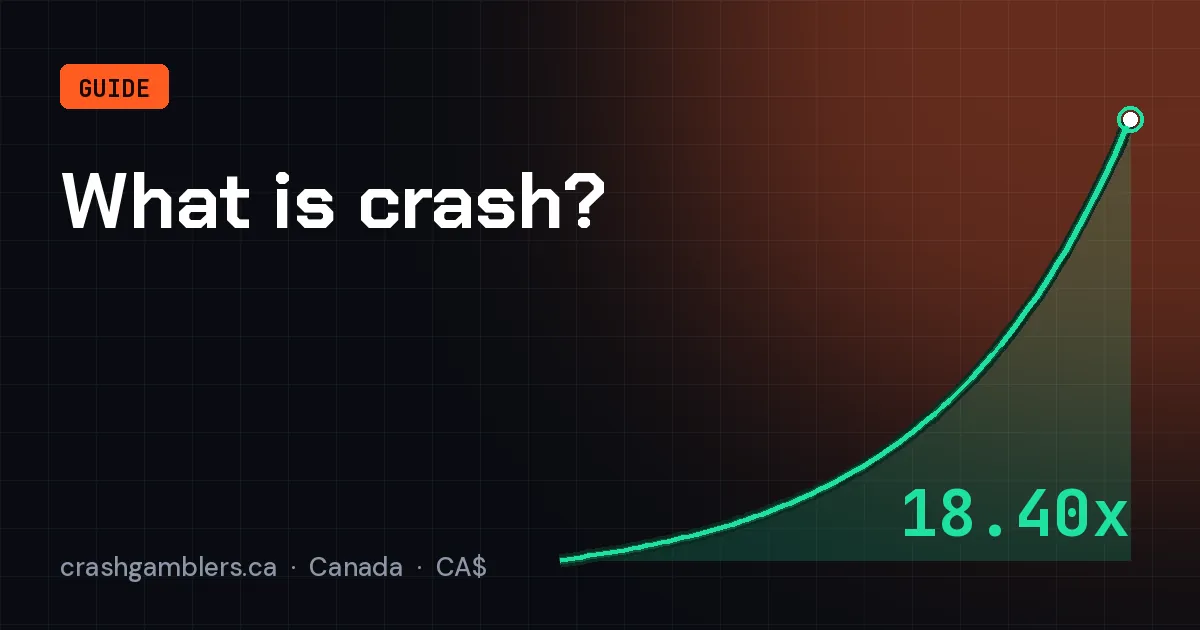
The multiplier on screen grows exponentially with time. Early on it moves slowly: getting from 1.00x to 2.00x takes a few seconds. Later it accelerates, so the climb from 10x to 20x feels much faster than the climb from 1x to 2x did, even though it doubles the same amount. That visual acceleration is deliberate. It builds suspense and makes high multipliers feel within reach.
The curve itself, however, tells you nothing about when the round will end. The crash point comes from a random number generator, typically converted into a multiplier with a formula that bakes in the house edge. On most crypto originals that edge is 1%, which produces a very clean probability rule:
The core crash formula: on a 1%-edge game, the chance that a round reaches at least multiplier m is roughly 0.99 ÷ m. So reaching 2x happens about 49.5% of the time, 3x about 33%, 10x about 9.9% and 100x about 0.99%.
If you want the derivation and comparisons between games, our crash odds and house edge guide covers it step by step, including how different edges change the numbers.
Cashing out: manual vs automatic
Cashing out is the only decision you make once the round is live, and there are two ways to do it.
Manual cash-out
You watch the multiplier and click (or tap) the cash-out button when you're satisfied. Manual play feels more engaging, but it has drawbacks. Human reaction time and internet latency mean you'll often cash out a little later than you intended, and occasionally a click that felt "in time" arrives at the server after the bust. Emotion is the bigger issue: it's easy to keep holding "just a bit longer" after seeing the previous round go to 40x.
Auto cash-out
Auto cash-out lets you set a target multiplier, such as 1.80x or 3.00x, before the round. If the multiplier reaches your target, the server cashes you out automatically, exactly at that number. If the round busts before your target, you lose. Because the server handles it, auto cash-out removes latency and impulse from the equation. Most experienced players use it for the bulk of their bets; our auto cash-out strategy guide explains how to pick a target.
| Feature | Manual cash-out | Auto cash-out |
|---|---|---|
| Precision | Depends on reaction time and connection | Exact target multiplier |
| Emotional control | Low; easy to hold too long | High; decision made before the round |
| Flexibility | Can react to each round | Fixed target unless changed |
| Best for | Casual, low-stakes fun | Disciplined sessions and autobet |
| Effect on house edge | None | None |
Note that last row. Neither method changes the odds. Auto cash-out simply ensures you take the payout you planned to take.
▲Crash SimulatorFree-play classic crash with virtual credits: rising curve, manual or auto cash-out and a full round history.Play free →The real odds and why the house always has an edge
Crash feels like a skill game because you choose when to stop, but mathematically every target gives the house the same advantage. On a 1%-edge game, a CA$10 bet with a 2x target wins CA$10 profit about 49.5% of the time and loses CA$10 about 50.5% of the time. Run that thousands of times and you lose around CA$0.10 per bet on average, which is 1% of your stake.
Change the target to 10x and you win CA$90 profit about 9.9% of the time, losing CA$10 the other 90.1%. The expected loss is still about CA$0.10 per bet. What changes is the variance: low targets give frequent small wins and smooth sessions, while high targets give long losing streaks broken up by big hits.
| Cash-out target | Chance to win (1% edge) | Profit on CA$10 | Expected loss per bet |
|---|---|---|---|
| 1.20x | About 82.5% | CA$2 | About CA$0.10 |
| 1.50x | About 66% | CA$5 | About CA$0.10 |
| 2.00x | About 49.5% | CA$10 | About CA$0.10 |
| 5.00x | About 19.8% | CA$40 | About CA$0.10 |
| 10.00x | About 9.9% | CA$90 | About CA$0.10 |
| 100.00x | About 0.99% | CA$990 | About CA$0.10 |
The speed of the game matters too. If a round takes around 15 seconds including the betting window, you might play 200 or more rounds an hour. At CA$10 a bet and a 1% edge, that's an expected cost of around CA$20 per hour, before any wild swings. Third-party crash games with a 3% edge (roughly 97% RTP) cost three times as much per hour at the same pace.
No system turns crash into a winning game. Martingale doubling, "pattern reading" and paid predictor apps cannot change the random crash point. Treat crash as paid entertainment with a known average cost.
Provably fair: why crash players trust the numbers
Most crypto crash originals are "provably fair". Before a round (or a series of rounds), the casino commits to a secret server seed by publishing its cryptographic hash. The crash point is then derived from that seed, a client seed and a round counter called a nonce. After the seed is revealed, anyone can recompute the result and confirm the casino didn't change the outcome after seeing the bets.
Provably fair proves the result wasn't tampered with. It does not mean the game is favourable to you; the house edge is still built into the formula. Our full provably fair crash guide includes a verification walkthrough.
Why crash is popular in Canada
Crash grew out of the Bitcoin gambling scene in the mid-2010s and arrived in Canada mostly through crypto casinos. A few factors explain why it caught on here:
- Crypto familiarity. Canada has a well-developed crypto market with FINTRAC-registered exchanges, so many players already hold BTC, ETH, LTC or USDT and can deposit quickly.
- Low house edge. A 1% edge compares well with many slots (often 3–6%) and is easy to understand.
- Speed and simplicity. A full round takes seconds and works well on a phone during a commute or between periods of a hockey game.
- Social features. Multiplayer crash shows other players' bets and cash-outs live, which adds a shared, almost spectator-sport feel.
- Rakeback culture. Crypto casinos return a slice of the house edge as rakeback, which appeals to players who wager often.
The regulatory picture is different by province. Ontario has its own licensed iGaming market and offshore crypto casinos generally don't accept Ontario residents, while players elsewhere often use sites licensed abroad. Read our guide to crash gambling legality in Canada before signing up anywhere.
Where Canadians play crash
Crash is offered mainly as an in-house "original" at crypto casinos, where it typically carries a 1% edge, and as third-party branded games with slightly higher edges. If you're outside Ontario and want a single starting point, Stake runs its own Crash, Slide and Limbo originals, and code GETRAKEBACK unlocks rakeback on your wagers. Check the bonus terms on the site before depositing.

GETRAKEBACKClaim at StakeFor a ranked comparison of the crypto casinos we rank, including deposit options and rakeback, see our crash casinos page.
Playing crash responsibly
Crash's speed is both its appeal and its main risk. Rounds come quickly, losses can stack up in minutes, and the "near miss" of a bust just below your target is very effective at keeping people playing. A few habits help:
- Decide a session budget in CA$ before you deposit, and never top up mid-session.
- Set a time limit as well as a loss limit; the hourly cost grows with the number of rounds.
- Use auto cash-out so decisions are made calmly, before the round.
- Don't chase losses by raising your bet size after a bust.
- Remember that crypto price swings can add to (or hide) gambling losses.
If gambling stops being fun, help is free and confidential. In Ontario call ConnexOntario at 1-866-531-2600, in BC call Gambling Support BC at 1-888-795-6111, in Quebec call Jeu : aide et référence at 1-800-461-0140, or dial 2-1-1 anywhere in Canada. Our responsible gambling page lists more tools, including self-exclusion.
Frequently asked questions
Is crash gambling just luck?
Yes. Each round's crash point is generated randomly before the round starts, so no timing trick, pattern or app can predict it. Your only real decisions are how much to bet and when to cash out.
What happens if I don't cash out before the crash?
You lose your whole stake for that round. Crash has no partial refunds: either you cashed out before the bust and got stake times your multiplier, or you lost the bet.
What is a good multiplier to aim for?
There is no 'best' target, because every target has the same expected loss of about 1% of the stake on a typical 1%-edge game. Low targets like 1.5x win often in small amounts; high targets like 10x win rarely but pay more. See our low vs high multipliers guide.
How long does a crash round last?
Usually somewhere between a fraction of a second and about a minute. A round that busts at 2x typically lasts only a few seconds, while a 100x round can run for close to a minute, plus a short betting window between rounds.
Can I try crash without risking money?
Yes. Our free crash simulator uses the same math as real 1%-edge crash games, with play money only, so you can learn the timing and see how variance feels before deciding whether to play for real.
How old do I have to be to play crash in Canada?
You must meet your province's gambling age: 19+ in most provinces and territories, and 18+ in Alberta, Manitoba and Quebec.